Saturday, 14 March 2015

Form progress and stem bending, March 14/05

Friday the 13th has come and gone, today it was time to get back on the project. Stem form was ready, and the stock was soaking for 3 days. Fired up the propane burner for stream, hit the blank with 190degree stream for 90 minutes and it bent up beautifully. Dressed the white oak backbone, and set the fasteners in the form so its ready for the top to be covered, and faired overall. Last steps are to set the bands when the stems are set on the form, and the gunwale backers will need to be steamed to shape and attached. 


Plastic tube for soaking stem stock with high-tech duct tape to hold stock down into water


3 days of soaking air dried wood, ready for bending. 


Form ready, typical system has wood tabs with a dowel , and a wedge driven down to hold. Works great, but c clamps offer as much or more clamping pressure, and are quick. 


Steel backing strap prevents tension failures during bending.


Bent and clamped, to set for a few weeks before removal and halving. 


Stem shape


Steam, lots of steam. 


Heading to 200degrees


With some time to spare during heating, took care of part of another project and milled up ash gunwale stock for a project boat coming in soon.  


Hold down bolts set into form for strongback, next to close it in and fair. 
Working in the shadow of the original provides lots of inspiration as the end is in sight, and so close 
to a new build.


Awesome quarter sawn white oak strongback, thanks to Rob's eye while at a sawyers. At 2.5"x3"x14 feet, is solid and perfect. 


Dressed on the planer, the fleck from quarter sawing is evident. 
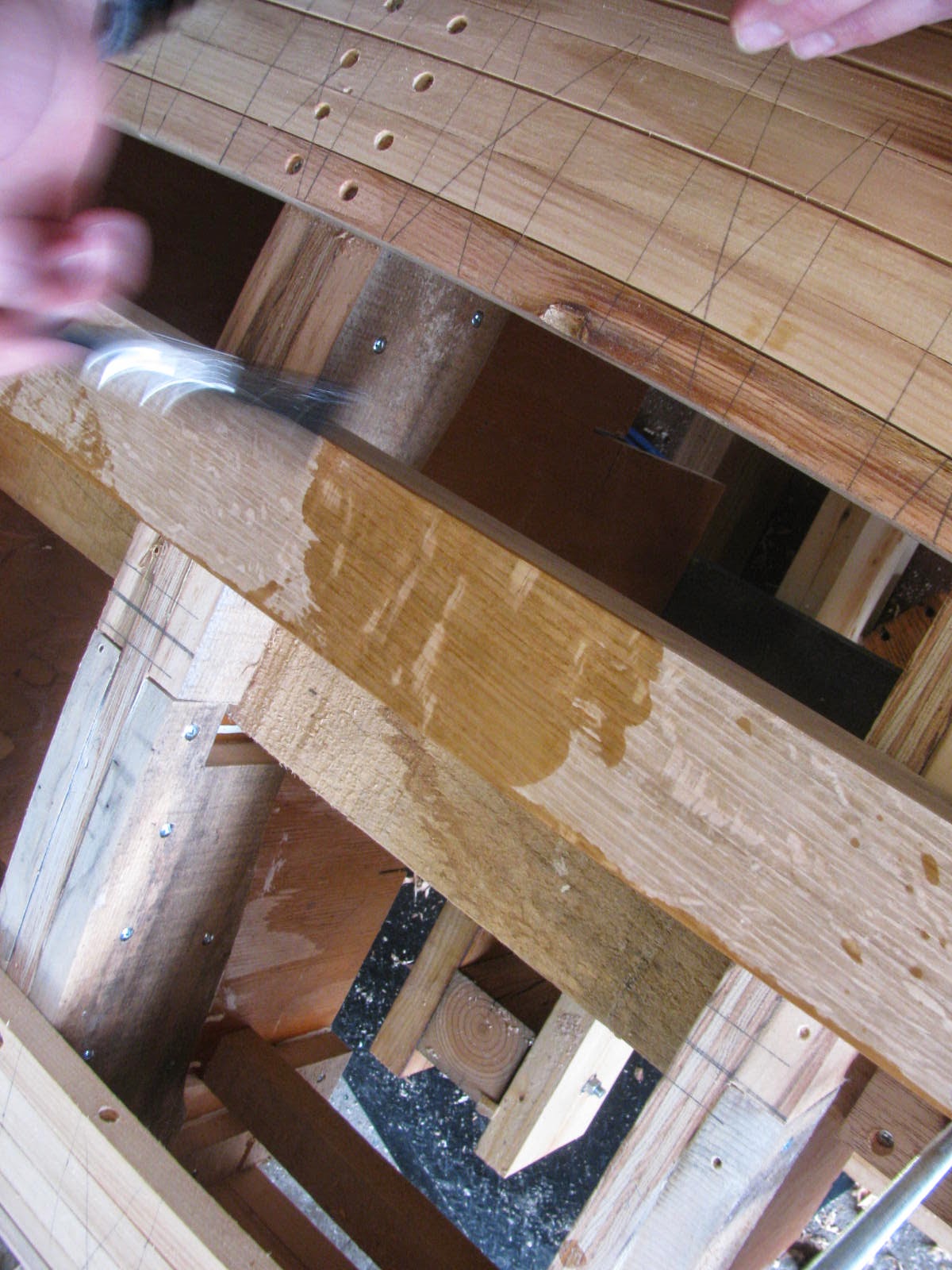


Hit with Tung Oil, it looks great. 


Next, closing and fairing, and steel straps, followed by gunwale backers. 


Wednesday, 4 February 2015

WOODS canvas canoe packs


From their website, the history of Woods Canada,:

A CANADIAN STORY. The Woods Canada story begins in 1885, when James W. Woods starts supplying lumbermen, miners, surveyors and other pioneers with canvas products, tents, sleeping bags and clothing to meet the toughest conditions required to explore and work in Canada’s harshest regions. From the Klondike Gold rush of the 1890’s to the first sailing of the Northwest Passage in 1905; from the great Arctic Expeditions of the early 20th Century to the first ascent of Canada’s highest peak, Mt. Logan, Woods became known as the most reliable and trusted outfitter for the most adventurous Canadians. Today, over 125 years later, Woods remains committed to providing the best quality and value for all your outdoor adventures.

In the United States, a similar product is known as a Duluth Pack, from another long standing manufacturer of canvas and outdoor goods, as below:


While Duluth make a large range of canoe packs as well as other configurations of canvas packs, Woods has traditionally made 2 canoe packs designated as models 100 and 200. Below on the left is the 200, which has a sheath for the head of an axe, and ties further up the side, along with a map pocket down the opposite side. The 100 has neither however has the same carrying capacity. 


The #1 Special features:
  • 69L/4200 cu in. (21"width x 35"high x 8"deep)
  • One large compartment
  • 10 oz water repellant cotton duck fabric
  • Straps secured by stictched and rivetied leather patches
  • Tear resistant seams are bound with webbing tape
  • Heavy duty leather tump and shoulder straps
The #200 Special features:
  • 69L/4200 cu in. (21"width x 35"high x 8"deep)
  • One large compartment
  • 10 oz water repellant cotton duck fabric
  • Straps secured by stictched and rivetied leather patches
  • Tear resistant seams are bound with webbing tape
  • Heavy duty leather tump and shoulder straps
  • Waterproof pocket in top flap
  • External leather axe sheath with buckle strap
  • Convenient side slash pockets

Currently for sale at   http://www.canadianoutdoorequipment.com/, they stock and sell the very best outdoor gear. Oddly enough, the bags cant be located on Woods own site.

I've had and carried a 200 for years, since it looks after the axe, and frankly who would go in the bush without one? While still very well made, the earlier packs used much heavier and more durable canvas. It would be fun to try to determine a timeline of bags, as the one we just picked up is thought to be an earlier one, with the logo stenciled on the inside rather than outside face. 


Nice heavy canvas


Logo stenciled on back


Closeup 


Earlier 100 or number 1 Special


Later 200 special we've had for close to 20 years


More to come as we collect more...


Saturday, 31 January 2015

Great Saturday spent gathering materials

Out around Tillsonburg we had the good fortune to meet a Sawyer with a tremendous amount of wood, including Cherry, Butternut, Maple, Chestnut, Elm, Tulip, Walnut, Basswood and more. With his own kiln, and an incredible knowledge both for wood and how to cut and process it, we picked up maple for decks, thwarts and seats. Although Chestnut may be more plentiful than is known, we got some and will return for more for stunning paddles, and maybe the odd Cruiser to be outfitted with decks seats and thwarts made of this wonderful looking wood. 

Stacks of walnut waiting for the kiln

Treasure shed...

Piles of quality stock

Many species and dimensions

More stock

Wormy figured maple, will make great paddles

Crotch cherry, walnut below for knife scales

Pile of chestnut on top


Lots of live edge

Up to have a look

We're really excited to have found chestnut, its a relatively rare tree for this area, and was used for canoe parts like decks, thwarts and seats by the earliest canvas canoe builders on the east coast, such as E.H. Gerrish.


http://en.wikipedia.org/wiki/American_chestnut      

The American chestnutCastanea dentata, is a large, monoecious deciduous tree of the beech family native to eastern North America. Before the species was devastated by the chestnut blight, a fungal disease, it was one of the most important forest trees throughout its range. There are now very few mature specimens of the tree within its historical range, although many small shoots of the former live trees remain. However, there are hundreds of large (2 to 5 ft diameter) trees outside its historical range, some in areas where less virulent strains of the pathogen are more common, such as the 600 to 800 large trees in northern lower Michigan.[1][2]

  Castanea dentata is a rapidly growing deciduous hardwood tree, historically reaching up to 30 metres (98 ft) in height, and 3 metres (9.8 ft) in diameter. It ranged from Maine and southern Ontario to Mississippi, and from the Atlantic coast to the Appalachian Mountainsand the Ohio Valley. It has several related chestnut species, such as the European sweet chestnutChinese chestnut, and Japanese chestnut, which are distinguishable from the American species by a few morphological traits, such as leaf shape, petiole length and nut size. C. dentata was once one of the most common trees in the northeastern US. In Pennsylvania alone, it is estimated to have comprised 25-30% of all hardwoods. The tree's huge population was due to a combination of rapid growth and a large annual seed crop in comparison to oaks which do not reliably produce sizable numbers of acorns every year. Nut production begins when C. dentata is 7–8 years old. The tree's survival strategy proved so successful that it may have ultimately become vulnerable to disease because of a near-monoculture in some locations. This natural event stands in comparison to other epidemics, such as Dutch Elm Disease and Emerald Ash Borer, caused by humans overplanting particular species of trees.

The American chestnut is a prolific bearer of nuts, usually with three nuts enclosed in each spiny, green burr, and lined in tan velvet. The nuts develop through late summer, with the burrs opening and falling to the ground near the first fall frost.
The American chestnut was a very important tree for wildlife, providing much of the fall mast for species such as white-tailed deer and wild turkey and, formerly, the passenger pigeonBlack bears were also known to eat the nuts to fatten up for the winter. The American chestnut also contains more nitrogen, phosphorus, potassium and magnesium in its leaves when compared to other trees that share its habitat. This means they return more nutrient to the soil which helps with the growth of other plants, animals, and microorganisms

The January 1888 issue of Orchard and Garden mentions the American chestnut as being "superior in quality to any found in Europe."[28]The nuts were once an important economic resource in the US, being sold on the streets of towns and cities, as they sometimes still are during the Christmas season (usually "roasting on an open fire" so their smell is readily identifiable many blocks away). Chestnuts are edible raw or roasted, though typically preferred roasted. Nuts of the European sweet chestnut are now sold instead in many stores. One must peel the brown skin to access the yellowish-white edible portion. The unrelated horse-chestnut's seeds are poisonous without extensive preparation.
The wood is straight-grained, strong, and easy to saw and split, and it lacks the radial end grain found on most other hardwoods. The tree was particularly valuable commercially since it grew at a faster rate than oaks. Being rich in tannins, the wood was highly resistant to decay and therefore used for a variety of purposes, including furniture, split-rail fences, shingles, home construction, flooring, piers, plywood, paper pulp, and telephone poles. Tannins were also extracted from the bark for tanning leather. Although larger trees are no longer available for milling, much chestnut wood has been reclaimed from historic barns to be refashioned into furniture and other items. "Wormy" chestnut refers to a defective grade of wood that has insect damage, having been sawn from long-dead, blight-killed trees. This "wormy" wood has since become fashionable for its rustic character.

The American chestnut is a prolific bearer of nuts, usually with three nuts enclosed in each spiny, green burr, and lined in tan velvet. The nuts develop through late summer, with the burrs opening and falling to the ground near the first fall frost.
The American chestnut was a very important tree for wildlife, providing much of the fall mast for species such as white-tailed deer and wild turkey and, formerly, the passenger pigeonBlack bears were also known to eat the nuts to fatten up for the winter. The American chestnut also contains more nitrogen, phosphorus, potassium and magnesium in its leaves when compared to other trees that share its habitat. This means they return more nutrient to the soil which helps with the growth of other plants, animals, and microorganisms.

Friday, 30 January 2015

Wetterlings Axes - New axe for tripping

For years, a Norlund Tomahawk pattern axe has been on the side of  my Woods 200 canvas pack. Its what is typically referred to as a Hudson Bay pattern, and lately Norlunds have been climbing steadily in price as they have evidently become collectible.  A great axe, when the second 200 pack showed up i went looking for another axe to hang on it. It could sit across the top of a  100 rather than bang around the floor of the canoe and risk getting lost, as the 100s dont have an axe sheath. 
Enter Dick Persson, owner of Buckhorn Canoe Company and importer of Wetterlings Axes, an long established maker in Sweden. 
Finding out that among their other great patterns they had done up a Hudson Bay  pattern, we had to have one. Today it arrived, thankfully a short trip with Canada Post. A flawless transaction, anyone considering doing business with Buckhorn wont be disappointed. 

Quick delivery !


Nice leather sheath, swee hickory handle


Even a booklet, albeit written in Swedish..


Norlund Tomahawk pattern


Wetterlings proof mark


Similar patterns


In place on the 200


Tomahawk model


Top profile, Wetterlings poll is slightly longer, and the cheek and cutting edge are nicely wedge shaped. the eyes are similar, and both have the characteristic deep beard and no lugs.


Much more pronounced wedge on the Wetterlings, should cut and split small stock wonderfully.


100 and 200 packs.


Saturday, 24 January 2015

More Form Progress

Continued from earlier post....


Closing in on the top, as it flattens out a single wide piece will be put down


Top shot, cant say enough good about Bosch tools


Working towards the flat run on the bottom


Tumblehome preserved


Bolts for strongback will need to be put in place before closing in the top


Narrow entry shows well


More to come, should be building on it by spring.

Sunday, 18 January 2015

The Faithful Minivan

People pretty much hate minivans - or at least say that they do. I love mine. My first Japanese vehicle since telling GM to shove their overpriced, unreliable and poorly assembled products after driving nothing but for 20 years. New off the lot in 2006 and still going strong, its only been back to the dealership for maintenance and to fix problems i could have avoided.
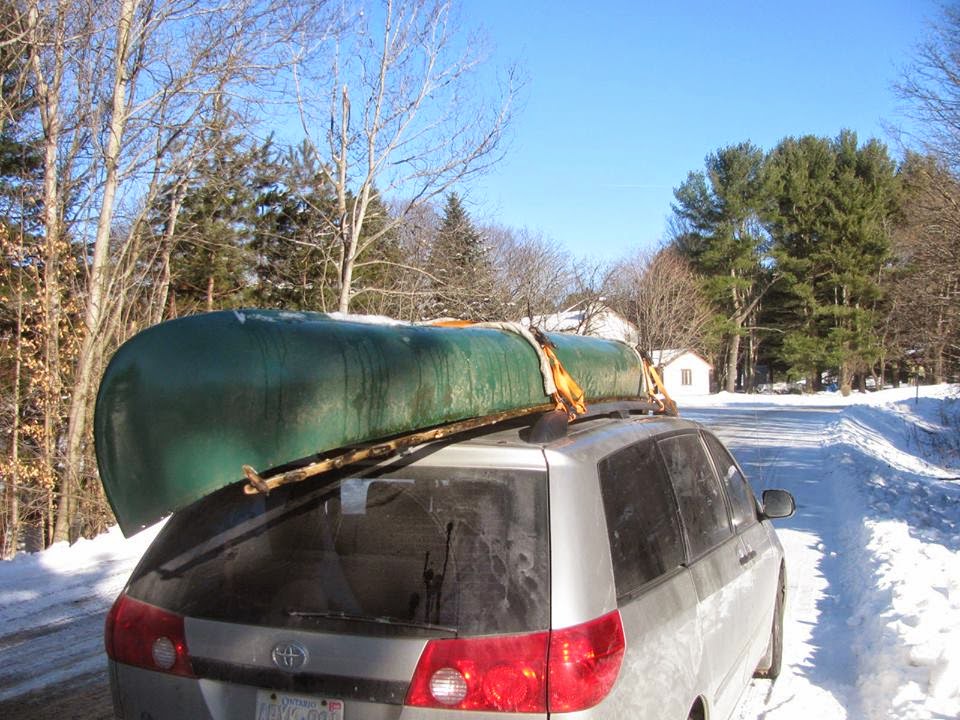
It pulls a trailer, i've slept in it, carries kids and gear and is relatively safe on the  highway. Fuel mileage is great, and i've had it off pavement on more gravel roads and trails that i bet most SUVs see. As i comb through old photo cards, these are some of the dozens of canoes its hauled home. If only i'd taken pics of EVERY one, but there are still more to come.


Wednesday, 7 January 2015