Showing posts with label birchbark. Show all posts

Sunday, 26 November 2017

Canoe Museum trip


The view heading to Peterborough, with an 18' Maine guide canoe on the roof.
Collected in 2015, and found here
 http://blog.ravenwoodcanoes.com/2015/07/maine-guide-canoe-continued.html
a rare example of the transitional early period from birchbark building to wood canvas, form built canoes. Too well preserved to give a cosmetic restoration, and too old to press into service paddling, it would be best kept in a collection where it could be interpreted and eventually displayed.


The decision was made to offer it to the Canoe Museum, and they were keen to acquire it

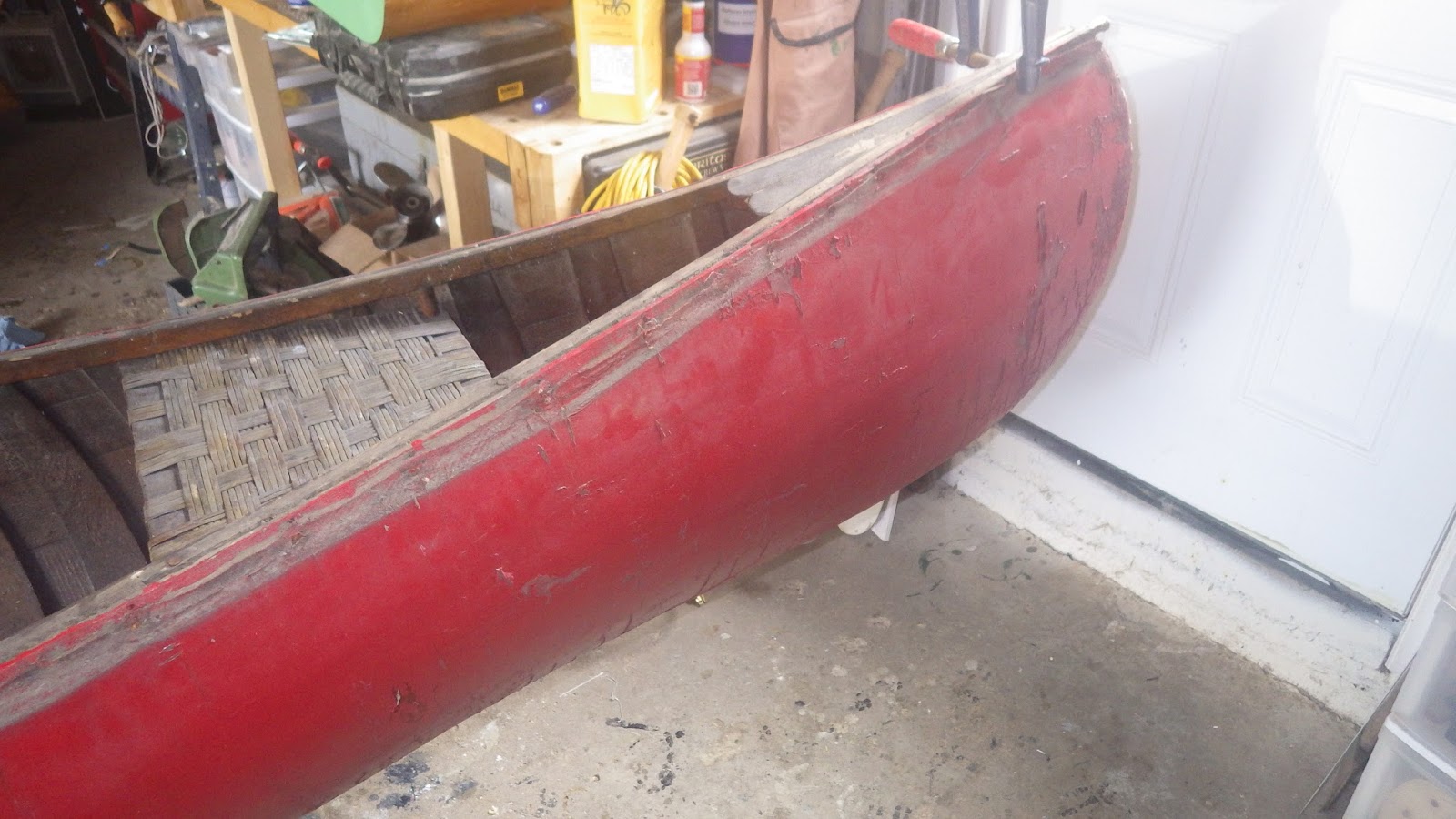
Down off the racks, covered in  years worth of sawdust

Typical of early Maine canoe construction, and reminiscent of early birch bark construction. 
The heavy tumblehome continues along the sheerline, all the way to the decks

Top and side caps missing, but still retains original seat caning. 

Showing the full ends and lower midships that were typical of a lot of guide canoe builders such as EM White and others. 

Rails extend beyond stem tips, and long narrow decks

Very fine, narrow entry in the ends. 

Arriving at the museum in Peterborough mid week; who wouldnt want a day off school

Yes, there is a gift shop

Jeremy having a quick look at some to the details

Nice early shape, perfectly suited to carrying a load. 
Currently there is no real representation of early form built, canvas canoes from the Eastern United States, where builders such as EH Gerrish are credited with developing cedar canvas construction, the next evolution after birchbark building. 


Yes, of course we managed to make sure the roof wasnt empty for the return trip home, with another stray coming back. The concept of one in, one out is upheld, at least for the time being....

Friday, 24 July 2015

Maine Guide Canoe, continued


Link to photos here

http://blog.ravenwoodcanoes.com/2015/06/early-guide-canoe-from-maine.html

The van snags another one, this time from Maine on a family trip to visit relatives. Found on a whim looking on Craigslist a week prior to leaving, this canoe exhibited features identifying it as a very early canoe, seemingly from the era when cedar canvas construction began to overtake birchbark constructionnd drew its influences from the former. 
The boat came from a family camp purchased by the sellers Grandfather in 1925, with the original lease on the property dating to 1895.  All that is known is that the boat was at the camp in 1925 and had been for some  years.   Best guess at the WCHA annual assembly this summer was a build date of approximately 1895, or thereabouts.  The boat has features common with EH Gerrish canoes, such as the deck and seats, and has ribs taperd in width as well as thickness after the turn of the bilge like an EM White, though isnt thought to have been built by either. 
A true survivor, it survived hard use and rot by living high in the rafters for years. It also managed to avoid fiberglass, and appears to be in its original canvas. Aside from some stem damage, it displays the usual alligatored varnish and cracking canvas paint, along with gunwale caps that had been crudely done. 
More photos to follow of the boats specific details.


18 feet long 


Heavy tumblehome evident


Full,deep ends and a low, wide midsection


Similar bircbark canoe


Almost its twin, remarkably similar recurve on the stems, heavy tumblehome etc. and more pictures to follow


Penobscot birch on the water, showing almost the same lines


Penobscot birch restored by Rick Nash for the Canadian Canoe Museum


Heart deck with lobes like Gerrish used


Typical Gerrish deck, courtesy Dragonfly Canoe


Woven  cane seats


Early seats from a Gerrish canoe after restoration


Lapped seat pieces, rather than solid pieces


Tumblehome , bow deck and rails need repair


Stem profile like Penobscot birch canoe


Rails extend past the stems as with early eastern canoes


Ribs taper in thickness through the turn of the bilge, an EM White characteristic - apparently done by whoever built this as well, as it is not a White.

Saturday, 19 October 2013

Material Gathering

Just as birchbark canoe builders gather bark, spruce gum, cedar, and spruce roots, the building of a cedar canvas canoe requires the gathering of materials as well. In order to build authentic replicas of the early Chestnut Guide,  we are adhering to its original configuration and list of materials. White cedar ribs and planks will, along with maple for the seats, thwarts and decks are not difficult to source , and even white oak for stems has been procured.  What does prove difficult however is long lengths of spruce for gunwale stock, either for single, closed gunwale construction or for the later style of open gunwale with both and inner and outer.  Chestnut was building in both styles before the factory fire of 1921.  During a weekend north walking the woods hunting for grouse, we visited a sawmill who had 2 30' logs they agreed to mill for us in an attempt to pruduce some clear stock.  Ash gunwales, or even cherry or oak are not over scarce, but clear spruce in lengths over 17' are rare as trees are both smaller, and no one cuts in those lenghts.  Lumber piles yield large rafter stock, however it has always been kiln dried and wont bend well afterwards.

Small pile of big cedar


Milling the log, 19' section


Second log

 
Moving stock around


BIG bandsaw


Starting to load - nice long stuff, much clear throughout.  

The write up of the Guide model early on specified that the lumber is not as selected as with the pleasure, and small knots and imperfections were allowed so long as they didnt weaken the board. As in many canoes, they can be hidden behind ribs where possible, however even our example has small knots visible in some areas. This was a Guides canoe after all, and with the heavier canvas it was meant for working.