Saturday, 10 November 2012

Chestnut sailing canoe

A while back another Chestnut found its way into the shop, this one built during the last of Chestnuts days in the late 1970s in the Oromocto NB factory. From the early part of the 1900s the factory was located in Fredericton, but later relocated in a last-ditch effort to revitalize manufacturing and compete with the popularity of  fiberglass and aluminum canoes. Indeed, they put their name on both, however the wood canoe was no longer in vogue. Roger MacGregor's book does a very in-depth explanation of this final period of The Chestnut Canoe Company, and the book is a tremendous amalgam of the company's history from before its inception.
This boat, while lacking some refinements characteristic of the period, is nonetheless in nice shape, with the wider, tapered ribs, one piece gunwales, and smooth hull. 
Having been recovered once, and used sparingly on Lake Muskoka the boat has no broken ribs or deformations in the hull.

It does have the typical deck and gunwale tip rot, which occurs when boats are left upside down on the ends on the ground.

Straight, true hull 16' long and 33.5" wide.

Oversided iron deck ring, and slightly different decal displaying Oromocto rather than Fredericton, which was used throughout the company's history albeit with minor changes.

As collected, the canoe had been recovered in Verolite, which was used by several manufacturers as an alternative to traditonal filled and painted canvas. It is a vinyl impregnated cloth, with the color put into the coating and requiring no additional work once put on. Unfortunately, it traps moisture and has the effect of causing canoes to rot, typically at the gunwales and rib tips, and this boat was on its way to starting although not in an advanced state. Once dried out and sealed it will be fine. 

Sloppy details typical of the later factory's method of production - a thwart that is barely shaped.  Visible is the orignal thin coating of varnish, which will make removal very easy.

Evidence of having been recovered, the newer and larger cup washers were over top of smaller ones used for the inital installation of the keel.

Planking along the port side ends with very thin pieces, similar to that used on Bobs specials and lightweight canoes

The Starboard side is planked with a more appropriate thickness for this model and size of canoe - no doubt the factory 'used what they had', or more accurately what was likely within reach.

Where is this all going? This boat does display a lot of the characteristics of later Chestnut production, however its purpose here is the basis for a new project. 
Some time ago we received a new lateen sail from a sailmaker who is the authority on historic sailing canoes and their rigs, Douglas Fowler. Located in Ithaca, NY he was the craftsman responsible for the sails on our 16/30s, and indeed can and will build any sails historic or modern.
A beautiful sail in a cream coloured dacron, it suggested we needed to find a boat for it. 
A while back we were fortunate enough to acquirea Wolf Pond sailing canoe built by the Old Town Canoe Company, and sold to one of the great camps of the Adirondacks in 1928. An incredibly rare canoe, these were noteworthy for their sailing gear which included a centerboard trunk built into the boat, along with a 15lb bronze centerboard. Previous open canoes with sails had used leeboards, and these continued to be manufactured into the 60s and 70s. Very few of these boats, however, had been made despite it being offered as a regular item in catalogues. As often happens, the boat was moved on to a new owner, however its rarity and great sailing characteristics have inspired us to create a replica, in essence 'the sailing canoe Chestnut never built.'
Picking up the Old Town in NY

Visible is the seat with sailing ring, along with centerboard trunk between the thwarts.


Bronze centerboard and rudder
3/8 sheet of aluminum that will be the centerboard for this project. Have to resist the urge to polish it!

Another Wolf Pond (they were built using the 17' OTCA form) showing trunk and centerboard

Depth of centerboard, which will of course kick up upon striking bottom or an obstacle in the water

The Old Town OTCAs of the period had lovely sweeping sheerlines, high stems and generous beams. The Chestnuts, while great paddlers and safe, open water canoes, do not possess the same styling. Nevertheless, it will make a capable sailor with a beam of 34" and overall depth of 12.5" and 16' in length. 

STAY TUNED!!
.

Couldnt leave it alone, cut off the steel hanger bolts, and underhung new rails. The ribs are fastened with steel nails, small diameter and heads so its just as well as most of them worked loose while pounding out the bolts. 

Little upsweep in the sheer means no steaming, rails fit right in. Leaving them heavier as the boat will be sailed, so the more strength the better to combat the torsional stress they will get

A common fix on canoes, and we've done lots, is to splice pieces into the gunwale tips. Structurally they are just as strong, and as they dont extend back beyond the deck they do not weaken the rails. In fact, as with most later Chestnuts, the rails on this boat were spliced in the middle. These rails are now one piece white ash. 
New rails were bent up and installed. Sheer dropped and center depth fell to 12.5", more appropriate for this model boat. Ends were kicked up to keep stem height, and introduce some sweep to the ends which always ends up looking better on a classic boat than a flat sheer.
Ends chopped out to make way for new upswept ends, along with much of top row  of planking removed to allow ribs to be fastened to new gunwales.
New tops will be put on to cant ribs, as ends pick up a bit of height. Stems will be rebuilt with new tops grafted on.
Ribs fastened to new rails, making for a nice solid boat.
New gunwales fastened and installed. Old rails and rib tips get cut off.
As the old saying goes, 'never enough clamps'. Spend any time around any boat shop and this is almost universally true.


Sunday, 23 September 2012

My Favourite Boats - to be continued...

Its been said that the best boats are the ones that get used the most, and while thats pretty accurate, there will always be those that get used rarely or not at all that will occupy the top of ones' list.
My favourite Chestnut canoe i am fortunate to own, a closed gunwale model from the earliest days of production before a fire wiped out the first factory in 1920. These boats were very close copies of BN Morris canoes from Maine, with lots of tumblehome, high sheers, and single or closed gunwale construction. After the fire when Chestnut was rebuilt, the old boats and their shapes were gone forever, as many more models were introduced and the old namesakes redesigned so they no longer resembled the original boats.
Below are some photos of some early boats, including what is belived to be a Moonlight model with a lady leaning over the gunwale, later used on an early catalogue.

My own boat is next, carefully and accurately restored by Dick Persson of Buckhorn Canoe Company, back during a time when I lacked the time to complete it myself. A masterful restoration, the boat was a derelict and can be seen on my website, in its as-found state. Nevertheless, it retains certain characteristics peculiar to Chestnuts of this period.


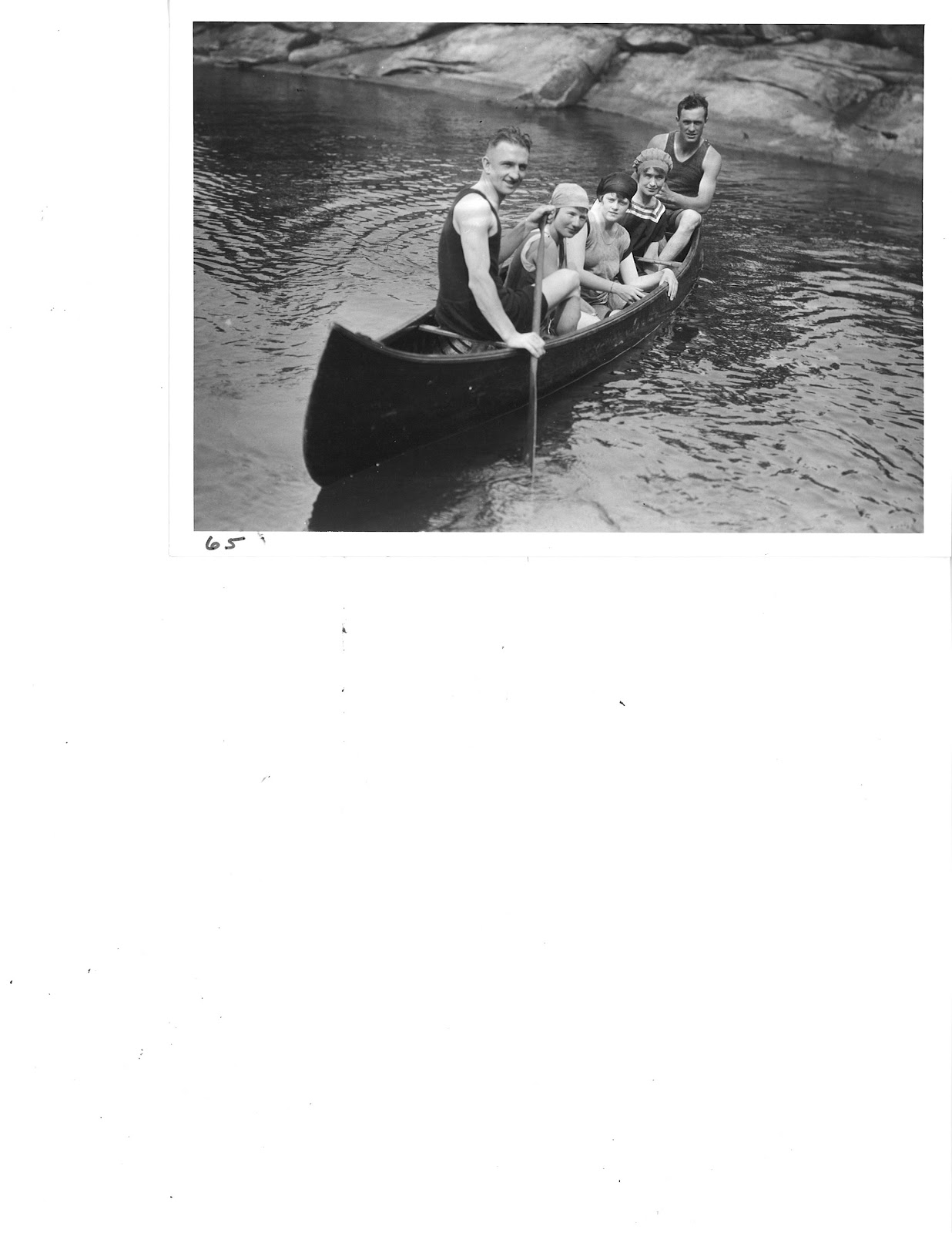
Finally, some great period shots of cottagers using a similar boat, and demonstrating that we've continued to grow larger and taller with each successive generation. Not likely that 5 adults could get in and have as much freeboard these days!

Found this nicely restored closed gunwale Chestnut for sale, would add it next to my own in a heartbeat if it wasnt 3 provinces over. With gas prices these days, it would be a costly trip even sleeping in the truck!
The restoration looks first class. The outer caps are too short and the profile could be better, but still a great job.
Unmistakably an early boat, from the Morris-like stem to the fine entry and tumblehome. The obvious clue that the boat is from before 1920 are the single, or closed gunwales. These were never built again after 1921 when the factory and building forms were rebuilt following a total loss fire.

All time favourite paddling canoe is of course our pre-fire Chestnut cruiser. Never have we been so anxious to paddle a boat, but short of a restoration or the completion of the form and a new build we wont be paddling it anytime soon, but our target is within the year, hopefully by this fall.


Saturday, 22 September 2012

Killbear 2012 and small canoes

For the past 15 years, there has been a Paddlers Rendezvous at Killbear Provincial Park near Nobel, just outside of Parry Sound Ontario. A low key, loosely organized gathering which varies in attendance year to year, and occaisionally produces a new boat, either a first time attendee or a newly completed project someone has brought.  Typically held the weekend after Labor Day, the event is open to all. More posts will follow with photos from previous years, however this year was subject to heavy rains which limited attendance, as well as activities. Nevertheless, it is Georgian Bay and not much short of lightning or a hurricane will keep me off of it.
This year, part of a project for the upcoming 2013 WCHA annual assembly, i donated a Chestnut Cronje - a great cruiser used for tripping by Camp Keewaydin, the oldest canoe tripping camp in existence and operating in Canada out of Temagami. The boat left for Massachusetts with friends that will completely restore it in time for it to be auctioned off, to raise proceeds for the organization. This boat was built in the mid-sixties, and has had a hard life and many thousands of miles of trips, summer after summer. Retired from the fleet of wood canvas boats the camp still uses and maintains, its one of several we have.
What the heck found its way on the trailer? A Mirror dinghy for free, but turned out to be too rotted to warrant the work to bring it back, so it has a date with the sawzall. The rig will be kept, but the boat is gone. The little boat in John Deere green seems to be a Peterborough Mermaid, or perhaps a Chestnut Playmate - we'll likely know for sure once its stripped. Found on a yard with a for sale sign and half full of water, it had to come home with the rest. 

Not one to leave things alone, it had to be paddled! Problem was, the canvas was split along the keel the full length of the boat. Luckily we had duct tape, or as i like to call it, race tape or hundred mile-an-hour tape from its applications on the oval tracks holding racecars together on Saturday nites after they traded paint. A mere 26' of tape and we were off. The canoe got lots of use, as at 14' they are not common, and it was a very stable, responsive and well behaved boat for its size.

17' Chestnut Cronje model, built by Donald Fraser.

Out of Camp Keewaydin's fleet in Temagami, this boat has been on numerous long trips, however unlike the majority of their boats, this one had not been rebuilt/repaired, and was as it was delivered in the mid-'80s. It was due for a recanvas, and some repairs. 


Donald Fraser had been the sales manager at Chestnut when they closed their doors in 1978/79, and with great foresight purchased several of the more popular molds, among them the Cronje and Prospector. 


He the continued to build and supply Keewaydin, the oldest canoe tripping camp in Canada, who still use cedar canvas canoes to this day. With Chestnut gone, he filled the void for some time. 


The boats are very well built, and of a higher caliber than Chestnut had produced in some years, owing to him being able to control every aspect of the build in a somewhat unhurried fashion, compared to factory production


Carry thwarts, unusual to Canadian boats but spec'd by Keewaydin


Fraser script, a similar font to the one Chestnut used in the 60s and 70s. Mr Fraser gave permission to reproduce the decals, so now we can complete any Fraser canoe we work on to the way he shipped it. 


Fleet number on the bow, K on the stern per tradition. 


Nearing completion, waiting for seats and stembands